
How Do Autogas Injector Rails and Gas ECUs Ensure Engine Performance and Fuel Efficiency?
The combination of a fast-acting Gas Injector Rail and an intelligent Gas ECU is critical for achieving original petrol-like driving dynamics, high fuel economy, and smooth idling.
Role of High-Speed Injector Rails
Gas injectors must open and close in milliseconds (ms) to match engine combustion cycles. Modern 2 ohm and 3 ohm injector rails provide:
Fast Response Times: Opening times under 2.5 ms for rapid acceleration and precise micro-metering.
Low Noise & Thermal Stability: Durable solenoid coils designed to resist high temperature under-hood environments.
Interchangeable Nozzles: Calibrated nozzle sizes (1.5mm to 3.0mm) adaptable to different engine horsepower outputs.
Advanced OBD II Gas ECU Calibration
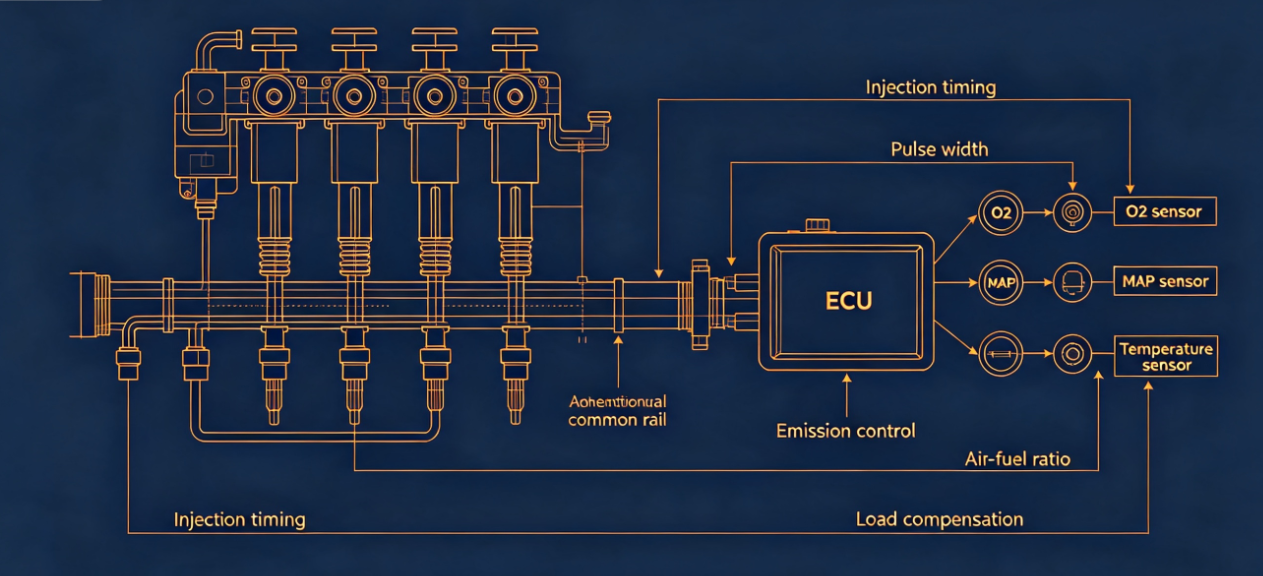
Modern autogas ECUs utilize advanced 32-bit processors with integrated OBD II / EOBD compatibility. The ECU continuously reads OEM fuel trims (STFT and LTFT) to automatically adjust gas injection maps in real time, preventing lean or rich fuel mixtures and eliminating engine warning lights (Check Engine Light).
Frequently Asked Questions
Why are high-speed injector rails important in autogas conversions?
High-speed injector rails open and close in under 2.5 ms, ensuring precise micro-metering of fuel to match rapid engine combustion cycles, which preserves original power and prevents hesitation.
How does OBD II integration in a Gas ECU prevent Check Engine Lights?
The Gas ECU reads real-time short-term and long-term fuel trims (STFT/LTFT) from the vehicle's original OBD II system and automatically auto-corrects gas injection maps to maintain ideal air-fuel ratios.